Decarbonising Freight with Confidence
Date
25 September 2026
Share

Chris Bowen, General Manager Delivery Partnerships, shares his perspective on the technologies, partnerships and practical decisions shaping the future of lower-emission freight rail in Australia.
Why is freight decarbonisation moving from aspiration to business necessity?
For many freight operators, decarbonisation is still competing with a long list of operational priorities. Rail assets are expensive, long-lived investments, and there is a natural reluctance to replace proven fleets before the technology, infrastructure and economics are fully understood.
What has changed in recent years is that sustainability is no longer sitting on the sidelines of business planning. Customers, investors and governments increasingly want to understand not only an organisation’s ambitions, but how those ambitions will be achieved.
At the same time, operators are recognising that maintaining the status quo is not a long-term option. The conversation has shifted from whether freight rail will decarbonise, to how and when that transition will occur.
Australia’s freight environment is also unique. Long distances, heavy haul operations and some of the harshest operating conditions in the world create challenges that differ significantly from many international markets. Solutions that have been successful elsewhere will not always translate directly to Australian networks.
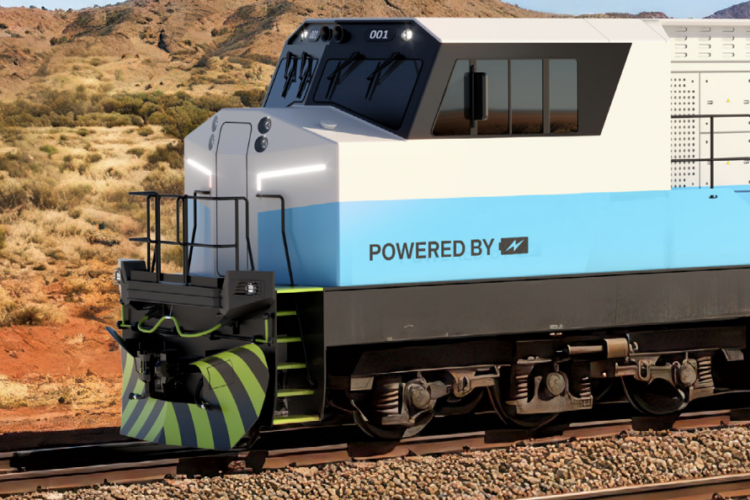
Render of Downer’s Battery-Electric Locomotive
"The focus needs to be on proving technologies in real operating conditions. The more evidence we can generate in live environments, the more confidence operators will have when making long-term investment decisions." Chris Bowen, General Manager Partnerships
What is the biggest misconception about freight decarbonisation?
Freight decarbonisation is often discussed primarily as an emissions challenge. In reality, it is equally an asset management challenge.
Most operators understand the need to reduce emissions. The greater challenge is determining what that means for fleets designed to operate for decades, while making investment decisions in an environment where technologies continue to evolve.
Many freight fleets still have significant operational life ahead of them. Replacing assets before the end of their useful life is rarely straightforward from either a commercial or operational perspective.
That is why the decarbonisation conversation must extend beyond technology alone. It is not simply about introducing new locomotives. It is about understanding fleet strategy, investment cycles, operational requirements and customer outcomes.
Ultimately, the organisations that make the most meaningful progress will be those that successfully align sustainability objectives with strong asset management practices and long-term business planning.
As the industry continues to explore pathways to lower-emission freight transport, collaboration, practical testing and informed decision-making will be critical to building confidence in the technologies that can support Australia’s future freight task.
Is there a clear technology winner emerging?
One of the most common questions in freight decarbonisation is which technology will ultimately emerge as the winner.
The reality is that most operators are not looking for a winner. They are looking for confidence.
From today’s perspective, battery-electric and hybrid battery-diesel solutions appear to offer the most practical near-term pathway for many freight applications. These technologies have the potential to deliver meaningful emissions reductions while fitting within existing operating models and operational requirements.
Renewable fuels are also expected to play an important role in supporting the transition. Many diesel fleets still have decades of useful life remaining, and alternative fuels may provide an opportunity to reduce emissions without requiring large-scale fleet replacement.
Hydrogen continues to attract interest across the sector; however challenges remain around infrastructure development, energy production, storage and overall system economics. For many operators, it is still viewed as a longer-term consideration.
What should operators be focusing on right now?
The good news is that organisations don’t need to wait for the next generation of technology to get started. Many operators are already reducing fuel consumption through better planning, driver advisory systems, idle reduction programs and operational improvements. These initiatives can deliver immediate emissions reductions while improving performance and reducing costs.
At the same time, operators should be building a clearer understanding of fleet age, replacement timing and which routes may be suitable for emerging technologies. Just as importantly, they need to look beyond the locomotive itself. Decarbonisation isn’t simply about introducing a new product. It requires consideration of charging infrastructure, energy supply, maintenance capability and, in some cases, future network electrification.
The organisations making the most progress are taking a whole-of-system view, connecting fleet strategy, infrastructure planning and operational requirements into a single roadmap.

What partnership opportunities exist?
No organisation is going to solve freight decarbonisation on its own. Operators understand their networks and customers. Technology providers bring engineering expertise and innovation. Governments, infrastructure owners, financiers and energy providers all have important roles to play.
At Downer, we’ve seen the power of this model in passenger rail. Delivering and maintaining complex rail assets requires organisations with different expertise to work together towards a common outcome. Freight decarbonisation will be no different. Success will depend on bringing together technology, infrastructure, operations and investment into solutions that work in the real world and can be delivered successfully.
Our role is to help connect those elements, reducing risk, testing new technologies in operational environments and helping customers move from concept to implementation with confidence.
Looking ahead to 2030, what does success look like?
By 2030, success won’t be measured by how many new locomotives we’ve introduced.
Success will be measured by whether operators can reduce emissions without compromising reliability, productivity or commercial performance.
I expect we’ll see battery-electric locomotives operating successfully across a range of Australian freight applications, supported by real operating data and proven business cases. Decarbonisation will increasingly be embedded within fleet planning and asset management rather than treated as a standalone sustainability initiative.
Australia’s freight task is unique. Success will come from developing technologies, partnerships and operating models that are proven to work in Australian conditions and give operators the confidence to invest.