
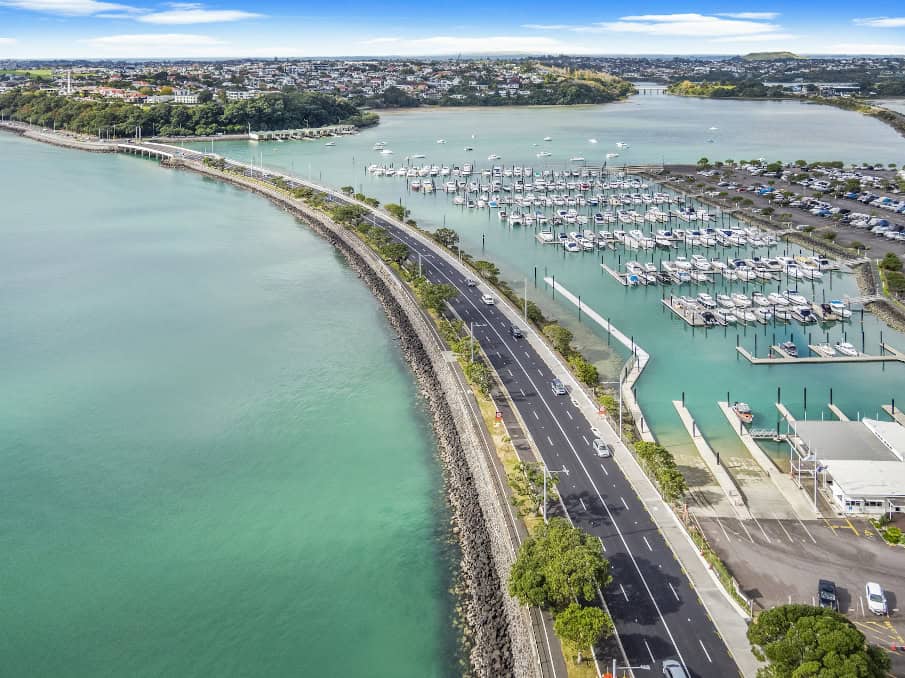
Designed to increase connectivity and safety for cyclists, pedestrians, and drivers, this project provided a 2.34 km bi-directional off-road cycleway on the northern side of Thorn Street to Tāmaki Drive in Auckland.
Tāmaki Drive is a busy road corridor with over 30,000 vehicles per day, and is also Auckland’s busiest route for cycling, averaging more than 1,500 trips per day.
The new cycleway required a new road configuration, including pavement widening and a new pedestrian bridge adjacent to the existing Point Resolution Estuary Bridge.
Project procurement incorporated a requirement for the contractor to deliver social, economic, and environmental sustainability outcomes at no cost to Auckland Transport under the tendered price. In response to this, Downer committed to identify, target, and track sustainability benefits, piloting its in-house sustainability framework, the Downer Sustainability Standard, during delivery. The framework provides a structured approach to sustainability delivery and is modelled on the Infrastructure Sustainability Council of Australia (ISCA) IS rating system.
Early in the project, Auckland Transport and Downer held a Materiality Assessment workshop to identify initiatives in priority areas and set specific targets from MCOS (Minimum Conditions of Satisfaction) to stretch targets. Priority areas included greenhouse gas emissions reduction, focusing on energy and materials used in construction, and ecological enhancement.
Key initiatives include:
- Replacing diesel generators with power from the grid to decrease CO2 emissions and cost
- Replacing in-fill for a raised section of pavement with layered asphalt to reduce CO2 emissions, construction duration, traffic impacts, and cost
- Preserving Pohutakawa trees within the project boundaries and planting new natives to enhance the ecological value of the corridor.
Sustainability initiatives implemented on Auckland’s Tamaki Drive cycleway have achieved a reduction in noise, traffic, air pollution, and resource use, and total greenhouse gas (GHG) emissions savings of 32.67 t CO2e over the 18-month construction period. The initiatives also achieved cost savings of approximately $35K (2.5% of contract value).
Discover more View all

HV/LV Network Upgrade
Read case study

Christchurch Southern Motorway Stage 2
Connecting Canterbury through safer, more reliable transport infrastructure Overview Christchurch...
Read case study

North and South Canterbury Network Outcomes Contracts
How Downer kept Canterbury’s State Highways moving Overview For around...
Read case study