
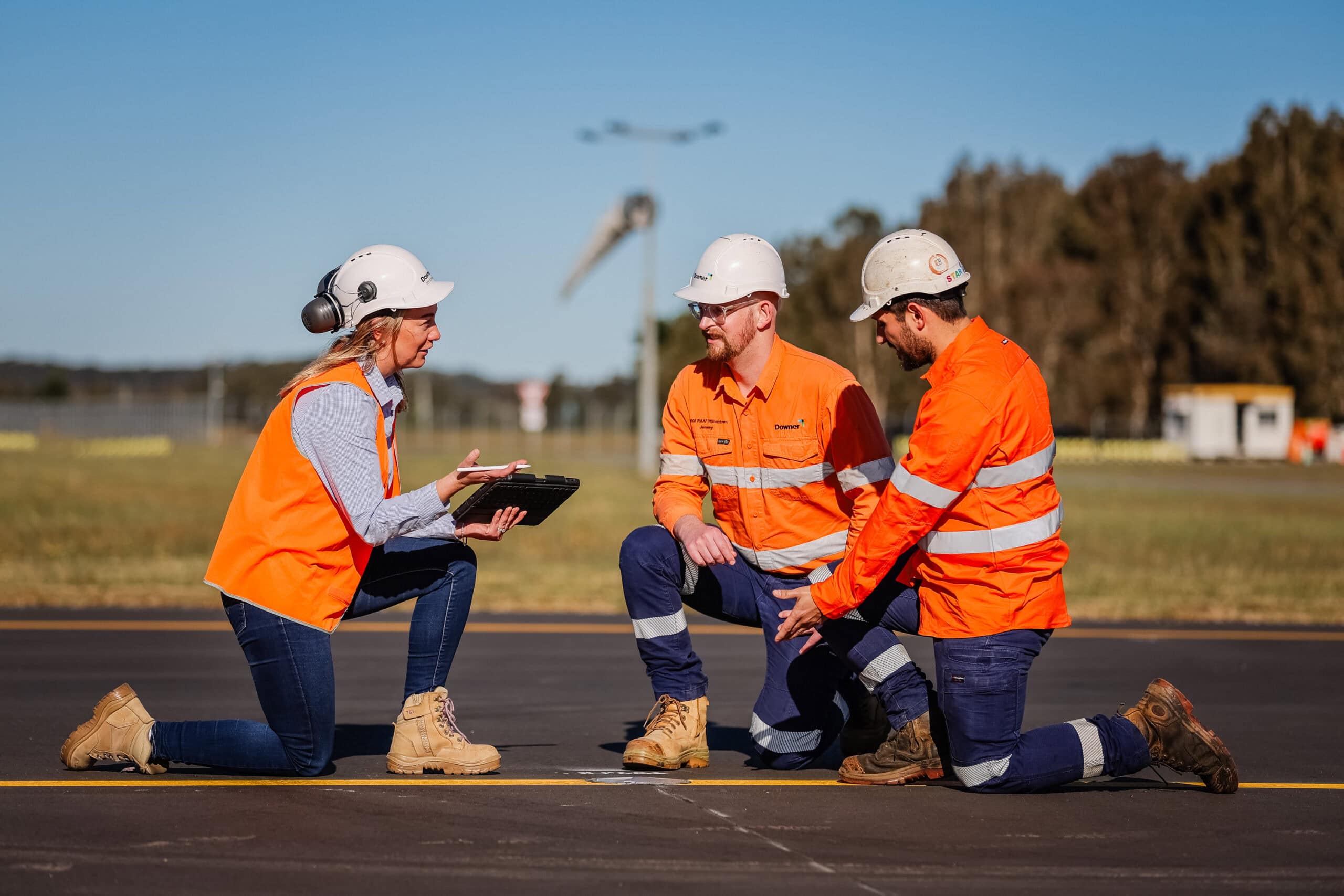
The RAAF Base Williamtown Pavement Reconstruction project was a major component of Defence’s National Airfields Program, focused on upgrading and maintaining critical airfield infrastructure at RAAF Base Williamtown, NSW.
Delivered under the first Early Contractor Involvement Head Contractor (ECIHC) contract, the project included:
- Full-depth runway reconstruction.
- Taxiway and apron resurfacing.
- Drainage improvements.
- Installation of new aircraft arrestor systems.
- Upgrades to aeronautical ground lighting (AGL) to accommodate Code E aircraft such as Airbus A330 and Boeing 777.
Works were staged to maintain 24-hour airfield operations and minimise disruption to Defence flying activities.
Challenge
Defence required the full-depth runway reconstruction while maintaining uninterrupted operational capability. The project involved complex staging, environmental constraints including PFAS-contaminated groundwater, and the integration of additional scope items without extending delivery timelines. Achieving high levels of local and Indigenous participation, while introducing advanced construction techniques in an operational airfield environment, added further complexity.
Solution
Downer was privileged to be involved from the outset, providing constructability and delivery advice to the Commonwealth during the planning stages before moving into delivery. The works required significant coordination with both military and civilian airfield operators to ensure minimal disruption to aircraft operations.
Key strategies included:
- Advanced planning and 4D engineering modelling to enable precise night-shift construction windows, reinstating over 1km of operational runway each night.
- AI-enhanced equipment and the Vogele 1800-3 Superpaver for wide paving runs, improving safety and quality.
- Cement-treated base mix to eliminate the need for an on-site pugmill, reducing truck movements.
- On-site PFAS treatment and reinjection strategies to manage environmental risks
- Turf installation along runway flanks to prevent environmental scouring and promote vegetation growth.
- Close collaboration with Defence stakeholders to safeguard operational continuity.
- Engagement with local suppliers and Indigenous businesses to maximise social and economic benefits.
Outcomes
The $181m project was successfully delivered over five years, meeting all contracted milestones while accommodating additional scope. Key outcomes included:
- Operational continuity throughout 426 night shifts with minimal impact to daily base operations.
- Completion of Infrastructure upgrades, including full-depth runway reconstruction, new arrestor systems, and AGL improvements to support Code E aircraft.
- Local industry participation at 85% and Indigenous engagement at 4.7%, exceeding targets.
- Environmental and safety excellence, with PFAS remediation strategies implemented and a Zero Harm safety culture.
- Strong community engagement, partnering with local suppliers, Indigenous businesses, and regional organisations to maximise social and economic benefits.
The upgrades are now complete, supporting Australia’s Defence air power capabilities and enabling Newcastle Airport to accommodate larger Code E civilian aircraft, delivering long-term economic and tourism benefits to the NSW Hunter Region.
Discover more View all
Riverina Redevelopment Program
Project Overview The Riverina Redevelopment Program (RRP) is a transformative...
Read case study

HV/LV Network Upgrade
Read case study

Christchurch Southern Motorway Stage 2
Connecting Canterbury through safer, more reliable transport infrastructure Overview Christchurch...
Read case study